 Book your Appointment

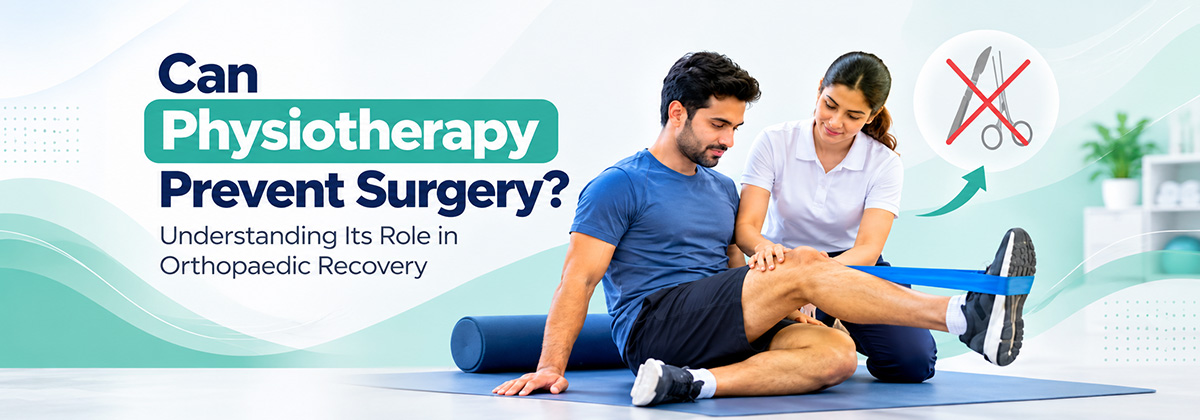
25 Oct, 2026 Can Physiotherapy Prevent Surgery? Understanding Its Role in Orthopaedic Recovery
Understanding Its Role in Orthopaedic Recovery
When persistent pain, stiffness, or weakness affects daily life, surgery may seem like the only solution. However, physiotherapy can often help reduce symptoms, improve movement, strengthen muscles, and restore function.
But can physiotherapy prevent surgery?
In some cases, it may help patients avoid or delay surgery. However, its effectiveness depends on the underlying condition, its severity, and whether surgical treatment is medically necessary.
What Is Physiotherapy in Orthopaedic Care?
Physiotherapy is a rehabilitation approach that focuses on improving movement, strength, flexibility, balance, and physical function. It may be recommended for people recovering from injuries, managing chronic musculoskeletal conditions, or preparing for and recovering from orthopaedic surgery.
Depending on the condition, physiotherapy treatment may include therapeutic exercises, strengthening exercises, stretching, mobility training, manual therapy, balance exercises, posture correction, and activity modification.
A physiotherapist first evaluates the patient’s symptoms, movement, strength, flexibility, and functional limitations before creating an individualised treatment plan.
Can Physiotherapy Prevent Surgery?
Physiotherapy may help some patients avoid or delay surgery, but it cannot prevent surgery in every case.
For certain conditions, symptoms may be influenced by muscle weakness, reduced mobility, poor movement patterns, or lack of physical conditioning. Addressing these factors through a structured rehabilitation programme may improve function and reduce discomfort.
For example, selected patients with knee pain may benefit from strengthening the muscles around the knee and hip, improving flexibility, and modifying activities that place excessive stress on the joint.
Similarly, some patients with back pain, shoulder problems, sports injuries, or movement-related conditions may improve with appropriate physiotherapy.
The goal should not be to avoid surgery at all costs. Instead, treatment should be based on the underlying diagnosis, severity of symptoms, and the patient’s individual needs.
How Can Physiotherapy Help Avoid or Delay Surgery?
1. Improves Muscle Strength
Weak muscles can increase stress on joints and affect the way the body moves. Targeted strengthening exercises can improve support around an affected joint and make everyday movements more efficient.
For example, strengthening the muscles around the knee and hip may improve stability and function in certain patients with knee problems.
2. Improves Mobility and Flexibility
Joint stiffness can make activities such as walking, climbing stairs, bending, or reaching difficult. Mobility exercises and stretching may help improve the range of motion when appropriate.
Improved flexibility and joint mobility can make daily activities easier and support better overall movement.
3. Helps Manage Pain
Not every painful joint requires immediate surgery. Depending on the underlying cause, physiotherapy for pain relief may help reduce discomfort by improving strength, mobility, movement patterns, and activity tolerance.
Rather than simply masking pain, physiotherapy aims to address physical factors that may contribute to movement-related symptoms.
4. Corrects Movement Patterns
The way you walk, sit, exercise, lift objects, or perform repetitive activities can sometimes place unnecessary stress on muscles and joints.
A physiotherapist can assess movement patterns and teach appropriate techniques that may help reduce unnecessary strain and improve functional movement.
5. Supports Injury Recovery
Following an injury, avoiding movement completely can sometimes lead to stiffness, weakness, and reduced confidence.
A structured rehabilitation programme can gradually restore strength, flexibility, balance, coordination, and function. Depending on the severity and type of injury, this may help some patients return to their normal activities without surgery.
Which Conditions May Benefit From Physiotherapy?
Several orthopaedic and musculoskeletal conditions may benefit from physiotherapy treatment as part of conservative care.

Knee Problems
Certain cases of knee pain, stiffness, weakness, and degenerative joint conditions may respond to exercise-based rehabilitation.
A physiotherapist may focus on strengthening the muscles around the knee and hip, improving mobility, and modifying activities that increase symptoms.
Back and Neck Pain
Many types of mechanical back pain and neck pain can be managed with appropriate exercises, strengthening, mobility work, posture education, and activity modification.
Physiotherapy may help improve physical function and make it easier to return to normal activities.
Shoulder Problems
Some shoulder conditions associated with stiffness, weakness, or soft-tissue problems may improve with rehabilitation.
Treatment may focus on restoring shoulder mobility, strengthening supporting muscles, and gradually improving functional movement.
Sports Injuries
Sports injury rehabilitation can help athletes regain strength, flexibility, balance, coordination, and sport-specific movement.
A gradual rehabilitation programme may also help determine when an athlete is ready to return to training or competition.
When Is Physiotherapy Not Enough?
Although physiotherapy can be highly beneficial, it is not suitable as a replacement for surgery in every situation.
Surgery may be considered when there is significant structural damage, severe instability, certain complete ligament or tendon injuries, fractures requiring fixation, advanced joint degeneration, or persistent symptoms despite appropriate conservative treatment.
For example, some patients with advanced joint degeneration may eventually require joint replacement surgery when pain and functional limitations significantly affect their quality of life and non-surgical treatment is no longer providing adequate relief.
Certain sports injuries may also require surgical treatment depending on the injury, instability, activity level, and functional requirements of the patient.
This is why a proper diagnosis and clinical assessment are essential before deciding between conservative treatment and surgery.
Physiotherapy Before and After Surgery
Physiotherapy can be useful even when surgery is eventually required.
Before surgery, prehabilitation may help improve muscle strength, mobility, physical conditioning, and confidence with movement. It can also help patients understand exercises that may be part of their rehabilitation after surgery.
After surgery, physiotherapy rehabilitation can help restore movement, strength, balance, flexibility, and functional abilities.
The rehabilitation programme usually progresses gradually. Early treatment may focus on safe movement and managing swelling or stiffness, followed by strengthening and functional exercises as recovery progresses.
The exact programme depends on the type of surgery, the patient’s condition, and their recovery goals.
Physiotherapy vs Surgery: Which Is Better?
It is not always appropriate to think of physiotherapy vs surgery as an either-or decision.
Physiotherapy may be sufficient for some conditions, while surgery may be necessary for others. In some cases, both treatments form different stages of the same recovery journey.
The right treatment depends on factors such as the diagnosis, severity of the condition, symptoms, physical function, response to conservative treatment, lifestyle, and individual goals.
The objective is not simply to avoid surgery but to choose the treatment that provides the most appropriate path towards improved function and quality of life.
Frequently Asked Questions
1. Can physiotherapy completely prevent surgery?
No. Physiotherapy may help some patients avoid or delay surgery, but it cannot prevent surgery in every case. The outcome depends on the underlying condition and its severity.
2. Can physiotherapy help knee pain without surgery?
Yes, depending on the cause of the knee pain. Physiotherapy for knee pain may include strengthening, mobility exercises, movement correction, and activity modification.
3. How long should I try physiotherapy before considering surgery?
There is no fixed timeframe. It depends on the diagnosis, severity of symptoms, response to treatment, and individual goals. Your healthcare professional can assess your progress and recommend the next step.
4. Is physiotherapy useful before surgery?
Yes. Prehabilitation may help improve strength, mobility, and physical conditioning before certain orthopaedic surgeries and prepare patients for post-operative rehabilitation.
5. Can physiotherapy replace surgery for sports injuries?
Not always. Some sports injuries can improve with structured sports injury rehabilitation, while others may require surgery depending on the type and severity of the injury.
Conclusion
Can physiotherapy prevent surgery? In selected orthopaedic conditions, physiotherapy may help reduce pain, improve strength and mobility, restore function, and potentially avoid or delay surgery. However, it is not a guaranteed alternative to surgical treatment.
The right approach depends on the underlying diagnosis, severity of the condition, response to conservative treatment, and individual recovery goals. If you are experiencing persistent pain, stiffness, weakness, or difficulty with movement, a professional assessment can help determine whether physiotherapy or another orthopaedic treatment may be appropriate for you.
At AOSM, a personalised approach to physiotherapy and orthopaedic rehabilitation can help you work towards better movement, improved function, and a more active lifestyle.


